
← All free classroom resources
Classroom organisation · Years 2-6
How can I help children turn feedback into a next step?
Convert one clear piece of task feedback into a manageable action and check.
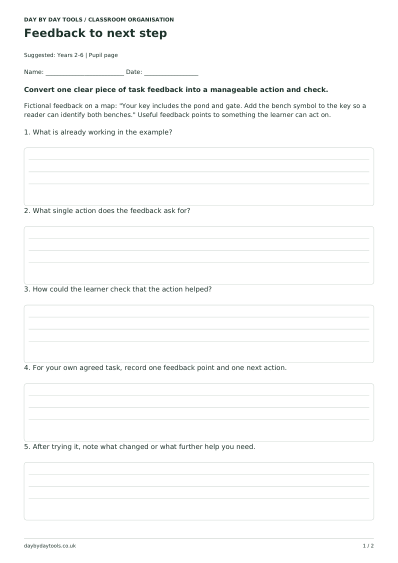
Download: Feedback to next step
A4 PDF · 2 pages · free · no sign-up
Print page 1 for the activity and keep page 2 for teaching notes, answers or review criteria.
Use A4 paper at 100% or Actual size. Suggested years or grades are selection aids, rather than curriculum alignment claims.
How to use this resource
- Translate add the bench symbol into one action, carry it out and test it against the original purpose.
- Use the supplied example or task brief. Let the learner respond through writing, drawing, discussion or their usual communication method.
- Review the answers or criteria below. Can the learner name the action and how they will know whether it addressed the feedback?
What is in the printable?
Fictional feedback on a map: "Your key includes the pond and gate. Add the bench symbol to the key so a reader can identify both benches." Useful feedback points to something the learner can act on.
- What is already working in the example?
- What single action does the feedback ask for?
- How could the learner check that the action helped?
- For your own agreed task, record one feedback point and one next action.
- After trying it, note what changed or what further help you need.
Make it easier or add challenge
More support
Read the feedback aloud, highlight one action and offer a model or accessible recording method.
More challenge
Rewrite vague feedback such as improve this into a specific question to ask the teacher.
What to look for
Can the learner name the action and how they will know whether it addressed the feedback?
Teacher answers and suggested responses
1. The key already includes the pond and gate.
2. Add a labelled bench symbol to the key, matching the benches on the map.
3. Ask a reader to use the key to identify a bench, or check that the symbol and label match.
4-5. Open-ended: choose a feasible action connected to the feedback. A request for clearer feedback or access support is a valid next step.
Further teaching guidance
Related guidance from EP for Schools: What kind of feedback helps a pupil take the next step independently?
Try another activity
Deliver individually or in a small group
Choose one learning aim from this activity. Model one example, work through another together, then give each pupil a turn with a fresh example. In a group, ask everyone to think or show a response before sharing; one confident answer does not show what the whole group understands.
Keep the task’s more-support option available. Allow the usual communication tools, practical materials or drawing where these preserve the learning aim. Reduce the number of examples if needed, rather than rushing through the sheet.
What progress should I look for?
Can the learner name the action and how they will know whether it addressed the feedback?
Note the example used and whether the response was independent, followed a general prompt or needed a model. Try a different example on a later occasion and look for clearer reasoning or less support on a comparable task. Use these observations to plan the next teaching step.
Printing, access and sharing
Use separate paper or a different recording method when more space or an accessible format is needed. Free to print and copy within your school, setting or family. Retain the website credit and share this teaching page with other settings.
Suggest a resource or report a problem →
Use this in a complete teaching collection
Planning and independence: prepare, do and review →
Follow a delivery plan, see worked examples and download a progress record and staff feedback sheet.