
← All free classroom resources
Maths · Years 3-5
How can I teach perimeter as distance around a shape?
Add all outer side lengths and distinguish perimeter from area.
Download: Perimeter paths
A4 PDF · 2 pages · free · no sign-up
Print page 1 for the activity and keep page 2 for teaching notes, answers or review criteria.
Use A4 paper at 100% or Actual size. Suggested years or grades are selection aids, rather than curriculum alignment claims.
How to use this resource
- Trace the whole boundary with a finger and record each side once before adding.
- Use the supplied example or task brief. Let the learner respond through writing, drawing, discussion or their usual communication method.
- Review the answers or criteria below. Look for every boundary side counted once and a length unit for perimeter.
What is in the printable?
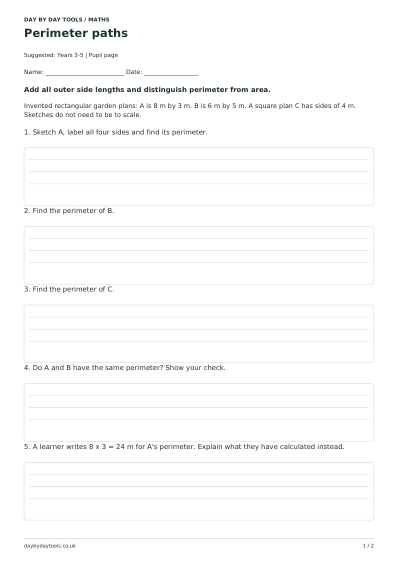
Invented rectangular garden plans: A is 8 m by 3 m. B is 6 m by 5 m. A square plan C has sides of 4 m. Sketches do not need to be to scale.
- Sketch A, label all four sides and find its perimeter.
- Find the perimeter of B.
- Find the perimeter of C.
- Do A and B have the same perimeter? Show your check.
- A learner writes 8 x 3 = 24 m for A's perimeter. Explain what they have calculated instead.
Make it easier or add challenge
More support
Provide a rectangle with all four side labels; use string around a real object before the sheet.
More challenge
Find another whole-number rectangle with perimeter 22 m and compare its area.
What to look for
Look for every boundary side counted once and a length unit for perimeter.
Teacher answers and suggested responses
1. 8 + 3 + 8 + 3 = 22 m.
2. 6 + 5 + 6 + 5 = 22 m.
3. 4 + 4 + 4 + 4 = 16 m.
4. Yes, both are 22 m.
5. 8 x 3 gives the rectangular area, 24 square metres, not the distance around the boundary.
Further teaching guidance
Related guidance from EP for Schools: How can we help pupils understand mathematical symbols?
Try another activity
Deliver individually or in a small group
Choose one learning aim from this activity. Model one example, work through another together, then give each pupil a turn with a fresh example. In a group, ask everyone to think or show a response before sharing; one confident answer does not show what the whole group understands.
Keep the task’s more-support option available. Allow the usual communication tools, practical materials or drawing where these preserve the learning aim. Reduce the number of examples if needed, rather than rushing through the sheet.
What progress should I look for?
Look for every boundary side counted once and a length unit for perimeter.
Note the example used and whether the response was independent, followed a general prompt or needed a model. Try a different example on a later occasion and look for clearer reasoning or less support on a comparable task. Use these observations to plan the next teaching step.
Printing, access and sharing
Use separate paper or a different recording method when more space or an accessible format is needed. Free to print and copy within your school, setting or family. Retain the website credit and share this teaching page with other settings.