
← Listening, vocabulary and oral language collection
Small-group printable · Activity 9 of 10Retell the problem and solution
Organise an oral retelling around a connected event.
Print and teach
A4 PDF · 2 pages · learner page + separate adult notes and answers.
Suggested Reception-Year 3. Choose by current skill. Allow talk, pointing, drawing, writing or usual communication tools.
This is not a controlled decodable text. An adult can read the material aloud; record that support when reviewing responses.
Activity
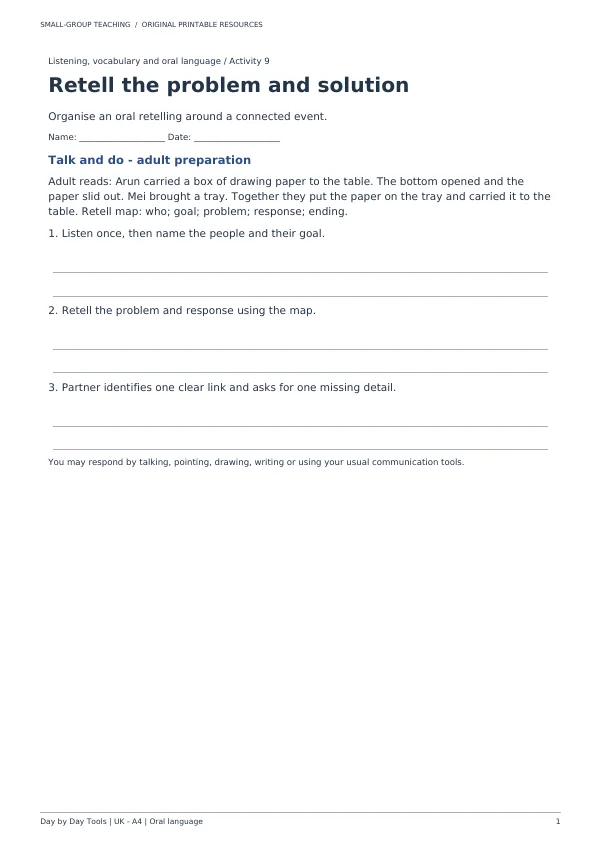
Adult reads: Arun carried a box of drawing paper to the table. The bottom opened and the paper slid out. Mei brought a tray. Together they put the paper on the tray and carried it to the table. Retell map: who; goal; problem; response; ending.
- Listen once, then name the people and their goal.
- Retell the problem and response using the map.
- Partner identifies one clear link and asks for one missing detail.
Model it
They got a tray is incomplete: I explain that the tray supported the paper after the box opened.
Delivery steps
- Introduce the words using real objects, examples or an accessible demonstration.
- Model a short speaker-listener exchange. Let partners rehearse with the task visible.
- Give each learner a fresh turn; the listener checks meaning and the speaker repairs the message if needed.
Answers and acceptable responses - for the adult
- Arun and Mei; move drawing paper to the table.
- Box bottom opens, paper falls; Mei brings a tray, they use it to carry the paper.
- Do not require exact wording. Retelling should keep who did what and how the response addresses the problem.
Support
Reduce the number of objects or choices. Allow extra processing time and usual communication tools. Adult may scribe or offer a starter; do not insist on eye contact or a spoken response.
Extend and transfer
Apply the same language move to a current classroom task with a new partner or new objects. Fade the starter only when it remains helpful to do so.
Look for progress
Record what the learner understood and what message they produced separately. Note the exact cue or visual support used; revisit with a new example.
If an instruction breaks down, reduce the language load and demonstrate its meaning, then retry a fresh example. Revisit a word through examples and non-examples. Separate difficulty understanding a message from difficulty producing speech.