
← All free classroom resources
Maths · Year 2
How can I use arrays to teach multiplication?
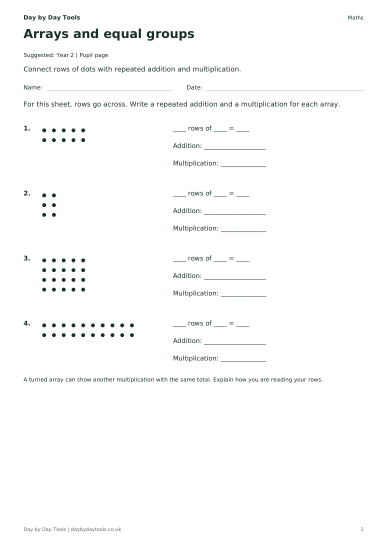
Arrange objects in equal rows and connect the arrangement to repeated addition and multiplication. An array makes the equal groups visible and supports discussion of the two orientations.
Download: Arrays and equal groups
A4 PDF · 2 pages · free · no sign-up
Print page 1 for the activity and keep page 2 for teaching notes and answers or suggested responses.
Use A4 paper at 100% or Actual size. Choose by the task and your class; the suggested range is a starting point, not a curriculum-alignment claim.
How to use this resource
- Build one printed array with counters.
- Describe its rows and the number in each row, then write repeated addition.
- Record the multiplication and turn the array to discuss the related fact.
Make it easier or add challenge
More support
Cover some examples and work with one small array using movable counters.
More challenge
Create two arrays with the same total and compare their multiplication sentences.
What to look for
Can the child identify equal groups and explain the chosen orientation? Accept a commuted fact when the explanation matches the array.
Teacher answers and suggested responses
1. 2 rows of 5 = 10; 5 + 5 = 10; 2 x 5 = 10.
2. 3 rows of 2 = 6; 2 + 2 + 2 = 6; 3 x 2 = 6.
3. 4 rows of 5 = 20; 5 + 5 + 5 + 5 = 20; 4 x 5 = 20.
4. 2 rows of 10 = 20; 10 + 10 = 20; 2 x 10 = 20.
A useful next step
Printing, access and sharing
Allow drawing, discussion, practical materials or usual communication tools where they support the learning aim. Use separate paper if a child needs more writing or drawing space.
Free to print and copy within your school, setting or family. Retain the website credit and share this resource page with other settings.