
← All free classroom resources
Literacy · Years 2-3
How can I teach children to choose sentence punctuation?
Read for meaning before choosing punctuation. Children need to decide whether a sentence tells, asks or expresses something strongly, then check the capital letter and ending rather than adding marks at random.
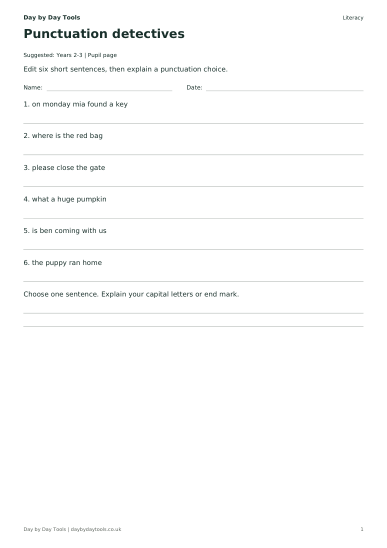
Download: Punctuation detectives
A4 PDF · 2 pages · free · no sign-up
Print page 1 for the activity and keep page 2 for teaching notes and answers or suggested responses.
Use A4 paper at 100% or Actual size. Choose by the task and your class; the suggested range is a starting point, not a curriculum-alignment claim.
How to use this resource
- Read one unpunctuated sentence aloud with a neutral voice.
- Discuss its meaning, choose an ending and reread it with that expression.
- Edit the six sentences and explain one decision using the actual words.
Make it easier or add challenge
More support
Work on statements and questions first. Offer a full stop and a question mark as two choices and read the sentence aloud.
More challenge
Ask children to show how two possible endings change the same sentence. Discuss which interpretation fits best.
What to look for
Can the child explain a question mark by referring to a question, rather than saying that the sentence is long? Some expressive endings allow justified alternatives.
Teacher answers and suggested responses
On Monday Mia found a key.
Where is the red bag?
Please close the gate.
What a huge pumpkin! (A full stop can also be reasonable, depending on intended expression.)
Is Ben coming with us?
The puppy ran home.
A useful next step
Printing, access and sharing
Allow drawing, discussion, practical materials or usual communication tools where they support the learning aim. Use separate paper if a child needs more writing or drawing space.
Free to print and copy within your school, setting or family. Retain the website credit and share this resource page with other settings.