
Following instructions
Developed by Dr Ian Corban, Educational Psychologist
6 weeks · 12 sessions2-4 pupils15-20 minutesYears 1-4Free
Carry out short classroom instructions, using repetition or a visual sequence when needed, and ask for clarification when information is missing.
39 pages · A4 · no account needed
How to use this programme
Starting skills
Can identify a pencil, book, cup and counter and access a simple spoken or signed instruction. Check hearing access, language understanding and motor demands first.
Prepare
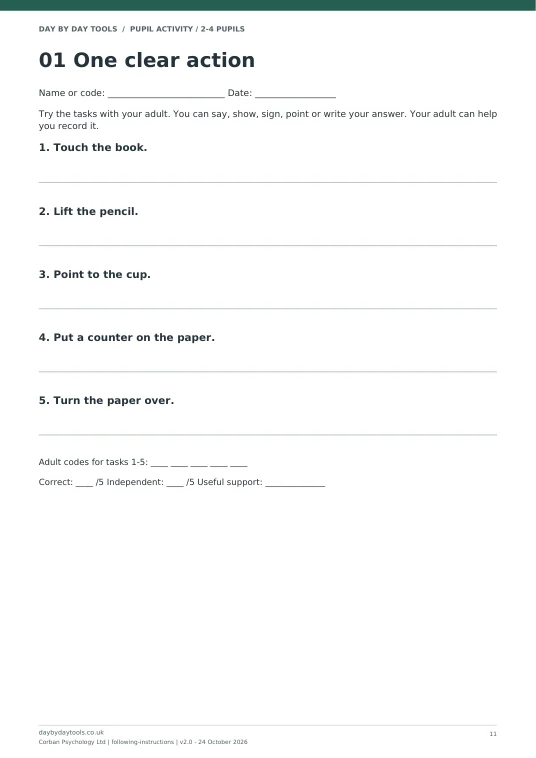
Pencil, book, cup, paper, two counters, ruler; one set per pupil. Adult reads task cards; print a pupil sheet per session.
Agree a classroom goal with the teacher. Use check A before teaching, check C at session 6 and check B before session 12. Each session follows prepare, model, practise and review. Repeat or adapt a step when needed; keep support available.
This is support for understanding and using instructions, not a test or training course for general working-memory capacity.
Evidence and references
Uses short language, demonstration, rehearsal and a gradual reduction in adult prompts. These choices apply oral-language and explicit-teaching principles.
Evidence-informed teaching resources. This particular programme has not been independently evaluated. The six-week schedule and local progress checks are not validated measures or a guarantee of improvement.
- EEF. Oral language interventions, Teaching and Learning Toolkit
- EEF (2020). Special Educational Needs in Mainstream Schools
Sources checked 24 October 2026. No endorsement by the cited organisations is implied.

Progress you can report
Starting, midpoint and final checks · accuracy and adult help recorded separately · individual session record · classroom observations · teacher/SENCo summary.
One record per pupil. These local checks are not standardised tests. Match access arrangements and report incomplete checks or changed conditions.
The twelve sessions
Classroom photographs are AI-generated illustrations of the activities.